
FAAC Gate Repair in Hermosa Beach: A Homeowner’s Guide
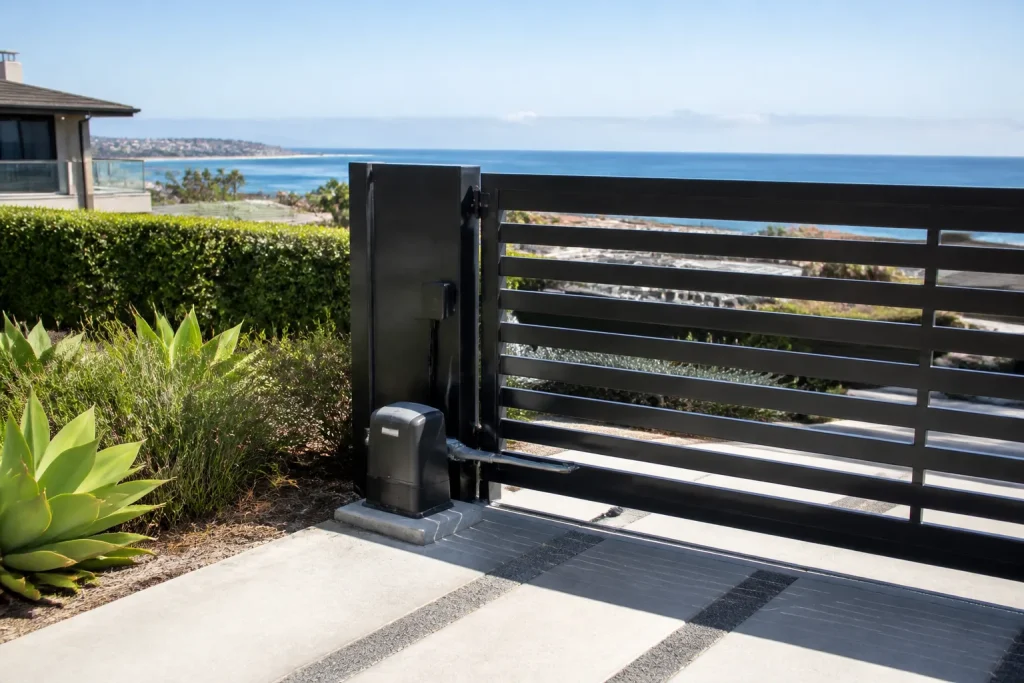
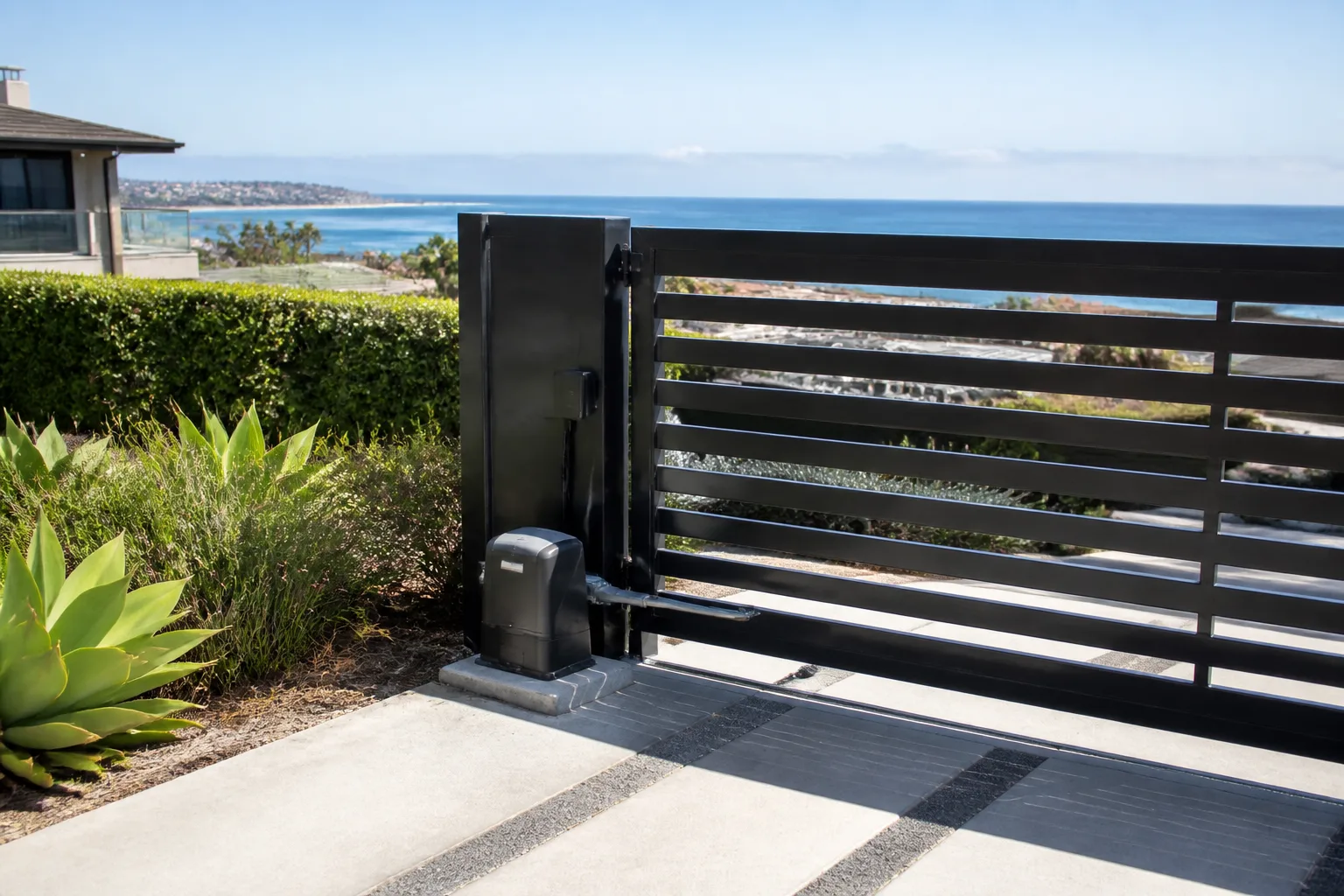
FAAC is one of the most reliable gate opener brands on the market, which means when a FAAC system fails in Hermosa Beach, it’s almost never the motor itself. It’s usually what the salt air did to everything around it. Most FAAC repair calls we take in Hermosa Beach involve corroded terminals, crusted limit switches, or control boards that look ten years older than they are. If your FAAC gate is acting up, this guide will help you understand what’s actually going on before anyone touches it.
If you’d rather skip the diagnosis and have someone who works on FAAC systems every week, call (279) 263-9485. Estimates are free, and we’ll tell you straight what needs fixing and what doesn’t.
Why FAAC Gates Fail Differently in Hermosa Beach
Every coastal city has salt air. Hermosa Beach has something extra: a marine layer that rolls in most evenings between May and August, leaving a fine film of moisture on everything it touches. That moisture carries airborne salt from the surf, and it settles directly onto the exposed electronics of your gate operator. The failure sequence is predictable. First, the salt and moisture combination attacks the copper traces and solder joints on the control board. Then it moves to the terminal block where sensor wires connect. Finally, it reaches the limit switches inside the operator housing.
This is not a slow, even corrosion. It’s electrochemical. When saltwater bridges the gap between two terminals carrying different voltages, it creates a miniature circuit where current flows where it shouldn’t. The board interprets that stray current as a sensor signal or a start command. That’s why a FAAC gate in Hermosa Beach might open on its own at 7 a.m., refuse to close at midnight, or sit there beeping like it’s trying to tell you something in Italian. In most cases, the motor is fine. The board is drowning.
What makes this worse is that FAAC enclosures, while solidly built, are designed for a European climate where the air behaves itself. A gate three blocks from The Strand in Hermosa Beach lives in a different world than the same gate in Bellflower. We’ve opened FAAC control boxes along Beach Drive that had green fuzz growing on the terminal strip within eighteen months of installation.
FAAC 400-Series vs. 800-Series: The Failure Patterns You Need to Know
FAAC makes two main families of residential swing gate operators: the 400-series, which uses electromechanical rams, and the 800-series, which uses hydraulic rams. They fail in different ways, especially in Hermosa Beach’s salt air. If you don’t know which family you have, take a look at the label on the operator housing. The model number is printed right there.
FAAC 400-Series: Electrical Failures
The 400-series operators like the 402 and 412 are gear-driven units, and they’re the ones Hermosa Beach homeowners most often have on single-family driveway gates. The gears and motor are well sealed, so mechanical wear is less of an issue than electrical corrosion. The weak points, in order of what we see most:
- Limit switch contacts inside the operator arm. Salt air causes a thin oxidation layer on the contacts, which gives the control board intermittent or missing “gate closed” or “gate open” signals. The symptom is a gate that stops halfway, then reverses, or sits there humming.
- Control board terminal corrosion. The plastic terminal blocks absorb moisture over time. When the screws and the wire ends corrode together, the connection becomes resistive. The board misreads sensor resistance as an obstructed gate.
- Capacitor failure from heat. The 400-series start capacitors sit inside a weather housing that gets direct sun in Hermosa Beach. Heat plus a salty film on the capacitor leads gives you hard starts or no starts in the afternoon heat.
One of our techs pulled a 412 off a gate over in the Golden Hills neighborhood south of Pier Avenue where the limit switch contacts had corroded so badly the board thought the gate was always open. The homeowner had been quoted a full control board replacement by a general handyman. It was a forty-five minute fix with a wire brush and dielectric grease.
FAAC 800-Series: Hydraulic Failures
The 800-series hydraulic operators are usually found on heavier gates: solid-wood driveway gates, metal estate gates, or anything with a lot of sail area that catches the ocean breeze. These units move the gate with hydraulic pressure, which matters because the service interval in Hermosa Beach is different from what the FAAC manual says.
The manual recommends checking hydraulic fluid every two years. In Hermosa Beach, we tell homeowners to ignore that. The issue is not fluid degradation. It’s the hydraulic ram seals. The same marine layer that attacks the 400-series electronics also settles on the exposed ram shaft. Salt crystals form, and every time the gate cycles, those crystals drag across the seal. The seal wears faster than the manual anticipates, and hydraulic fluid starts weeping out. You’ll see an oily film on the ram shaft and, eventually, a dark spot on the concrete where the fluid drips.
If a hydraulic FAAC operator is losing fluid, the gate gets sluggish first. Then it might not open all the way. Then it stops. Replacing seals before the ram scores is a modest repair. Replacing the whole ram because the shaft is pitted from running dry is a different conversation. In Hermosa Beach, we recommend a visual seal check every spring, not every two years.
FAAC Error Codes: False Alarms vs. Real Problems
FAAC control boards use blinking LED codes and display codes to tell you what’s wrong. The problem is that salt air makes those codes lie. Here’s what we mean.
A code indicating an obstacle detected, like the gate stalling then reversing, can be caused by a person standing in the way or by a corroded photocell connection that drops voltage intermittently. The board cannot tell the difference. It only knows it saw resistance or a sensor input it didn’t expect. Before you pay to replace a motor that “failed,” you want to know which codes are usually corrosion and which codes mean real money.
The codes and indicators that usually trace back to corrosion in Hermosa Beach:
- Photocell fault indicators that blink when the gate reverses or refuses to close. The sensors themselves rarely fail. The wire connections at the board corrode, or the sensor housings collect salt film on the lens. Cleaning costs nothing. Replacing a board costs plenty.
- Limit switch fault indicators that show the gate never reached a position. As described above, oxidized contacts are the usual culprit here.
- Flashing red LED on the board with no movement. Often this is a power supply capacitor issue where salt film on the capacitor leads creates a partial short. Not a board replacement in most cases.
The codes that mean real work:
- Motor overcurrent or short circuit codes. If the board is telling you the motor is drawing too much current, and the gate has been maintained, that’s usually a genuine motor winding issue. This is rare on FAAC equipment. We see maybe two or three of these a year in Hermosa Beach, and one of those was a gate that had been hit by a car.
- Hydraulic pressure faults on 800-series units. If the operator reports low hydraulic pressure, and the ram is not leaking, the pump itself may be wearing. Again, uncommon, but it happens on gates that have been in service on The Strand for fifteen years or more.
The point is this: half the FAAC “failures” we get called out for in Hermosa Beach are corrected with contact cleaner, new wire ends, and a seal check. The other half are legitimate mechanical issues. Knowing the difference saves you money, and it’s the reason we train our techs on FAAC specifically. A general handyman who “does gates sometimes” will often replace the board for a corrosion issue because the board is the expensive part, and replacing it is what he knows how to do. That’s a thousand-dollar guess you shouldn’t have to pay for.
What to Check Before You Call a Technician
You don’t need to fix anything. But if you can gather some basic information before you pick up the phone, the service call starts at diagnosis instead of at square one. Here’s what to do, in order.
- Document the exact symptom. Write down what the gate does, when it does it, and how long it’s been happening. “Won’t close after 4 p.m.” is different from “won’t close ever.” The marine layer pattern is a real diagnostic clue in Hermosa Beach.
- Try the manual release. FAAC operators have a release mechanism, usually a key or a small lever, that disengages the operator from the gate. Your manual shows where it is. Check whether the gate swings freely by hand once released. If it does, the gate itself is fine. If it doesn’t, the problem may be hinges or the gate frame, not the opener.
- Note the LED blink pattern on the control board before you power anything off. A slow blink versus a fast blink means different things, and the pattern changes back to a resting state after reset. Photo it with your phone if you can.
- Look at the visible wiring at the photocells and terminal strips. Green crust, white powder, or swollen wire sheathing tells you corrosion is in play.
- Do not attempt to open a live control panel with a metal tool while it’s powered. The board carries 24 volts on most FAAC units, but the transformer feeding it carries line voltage. If you’re not comfortable with a multimeter and rail-mounted terminals, your documentation job is done. Call someone who is.
A note on safety here. A FAAC operator moves a panel that can weigh several hundred pounds, and it’s connected to sensors and logic that can activate unexpectedly. The manual release is designed for homeowner use. Opening an operator housing and probing around inside is not something to learn from a YouTube video. We’ve seen a gate swing hard because a homeowner bypassed a safety circuit while testing. The gate doesn’t know it’s a test.
Once you’ve got your notes, call. A local gate company that works on FAAC systems will know what your notes mean, and you’ll save a service call’s worth of time explaining.
How Much Does FAAC Gate Repair Cost in Hermosa Beach?
Here’s the square deal on pricing. In Hermosa Beach, FAAC repair work falls into a predictable range. The number depends on whether the issue is corrosion cleanup, a component replacement, or a full operator swap.
Typical service ranges, as of 2025:
| Service | Typical Range |
|---|---|
| Diagnostic visit and corrosion cleanup (terminals, sensors, limit contacts) | $150-$275 |
| Photocell replacement (pair, including wiring cleanup) | $180-$320 |
| Limit switch replacement on 400-series operator | $240-$380 |
| Control board replacement (400-series or 800-series) | $600-$1,200 |
| Hydraulic ram seal service (800-series, per ram) | $260-$450 |
| Full operator replacement (including labor and programming) | $2,100-$3,800 |
These are real ranges for Hermosa Beach’s market, and the spread exists because no two gates are the same. A board replacement on a 412 with clean wiring is at the low end. A board replacement where the terminal strips need rebuilding because of salt damage is at the high end. The price you are quoted before any work starts will be the price you pay, and that’s in writing. We have been doing this since 1984, and we can tell you what a job costs before we touch it because we’ve done that exact job a hundred times.
When to Call a Pro (and When You Can Let It Ride)
Some FAAC quirks in Hermosa Beach are not failures at all. If your gate slows slightly in January when the marine layer is heaviest and then behaves all summer, you’re seeing thermal and moisture effects on the hydraulic fluid or the board, not the beginning of a death spiral. Note it, but you don’t need a service call for a gate that works fine 350 days a year.
But call a professional when:
- The gate reverses unpredictably with no one near it. That’s a sensor or board issue, and the gate can injure someone.
- The gate starts moving without a command. This is the most serious FAAC failure state we see in Hermosa Beach, and it’s almost always board corrosion. Cut power to the operator and call us.
- You see hydraulic fluid on the operator or the ground. That’s a seal issue that will get more expensive the longer it weeps.
- The gate gets louder over time. Hydraulic 800-series units get quieter as they warm up. If yours is getting louder, the pump or the seal is telling you something.
For related work in Hermosa Beach, we also handle full gate repair beyond the operator itself, and if a gate has reached the end of its useful life, our gate installation team handles the build from hinges to automation. If your FAAC opener is beyond repair, we’ll show you what a new motor setup costs with a straightforward quote before any bolts are turned. And if you’re new to us, you can start at the Ironworks Gate Co. home page to see the full scope of what we do.
One more thing. If you’ve got another brand on your gate, don’t assume this article doesn’t apply to you. We service LiftMaster, BFT, Linear, Viking, Ghost Controls, DoorKing, Elite, and Mighty Mule systems in Hermosa Beach, and the coastal corrosion patterns are similar across all of them. The brand changes where the components are and what the codes mean, not the fact that salt air is the main enemy.
The Bottom Line
FAAC gate systems in Hermosa Beach rarely fail from motor wear. They fail from marine-layer corrosion eating at the electrical connections, limit switches, and hydraulic seals. Diagnosing those failures accurately requires knowing the brand-specific failure patterns, and treating FAAC like a generic opener is how homeowners end up paying for boards they never needed. Document your symptoms, try the manual release, and call a company that works FAAC systems every week, not a handyman who will learn on your gate.
If you’re in Hermosa Beach and your FAAC gate is acting up, Ironworks Gate Co. offers free estimates. Call (279) 263-9485 and a live person answers, every time. We’ve been serving the South Bay since 1984, and we’ll be here another forty years.
Frequently Asked Questions
FAAC gate repair in Hermosa Beach typically runs $150-$275 for a diagnostic and corrosion cleanup, $240-$380 for a limit switch replacement, and $600-$1,200 for a control board replacement. The exact price depends on which FAAC model you have and how far the salt air corrosion has spread. Call (279) 263-9485 for a free estimate with no surprises on the bill.
A FAAC gate that moves without a command in Hermosa Beach usually has a corroded control board or a sensor connection carrying stray voltage from marine-layer moisture. This is a safety hazard and you should cut power to the operator and call a technician. It is rarely the motor itself.
Most FAAC repairs in Hermosa Beach are single-visit jobs. Corrosion cleanup on terminals and limit switches, sensor replacements, and board swaps are often completed in one trip. Larger jobs, like replacing a hydraulic operator, are scheduled after the quote is approved.
In Hermosa Beach, a FAAC 800-series hydraulic operator should have its ram seals visually checked every spring, not every two years as the manual suggests. The marine layer deposits salt crystals on the ram shaft, and those crystals wear the seals faster than FAAC’s standard interval accounts for.
Written by Victor Salinas, Owner at Ironworks Gate Co., serving Hermosa Beach since 2013.
Need Gate Repair Help?
Call Ironworks Gate Co. - licensed & insured, here with fast after-hours help in Hermosa Beach.
(279) 263-9485